


Introduction
Screws are one of the most widely used fastening components in construction, manufacturing, machinery, furniture, electronics and industrial assembly. Although they may look simple, screws play an important role in joining materials securely, allowing parts to be assembled, adjusted, repaired or replaced when needed.
Different screw materials, thread designs, coatings and head types can affect strength, durability, corrosion resistance and installation performance. Choosing the wrong screw may lead to loosening, breakage, rusting or fastening failure. This article explains the basics of screws, common types, material options, applications, purchasing considerations and industry trends.
Table of Contents
Section One: What Are Screws and Why Are They Used Everywhere?
How screws work and why they are important in fastening applications
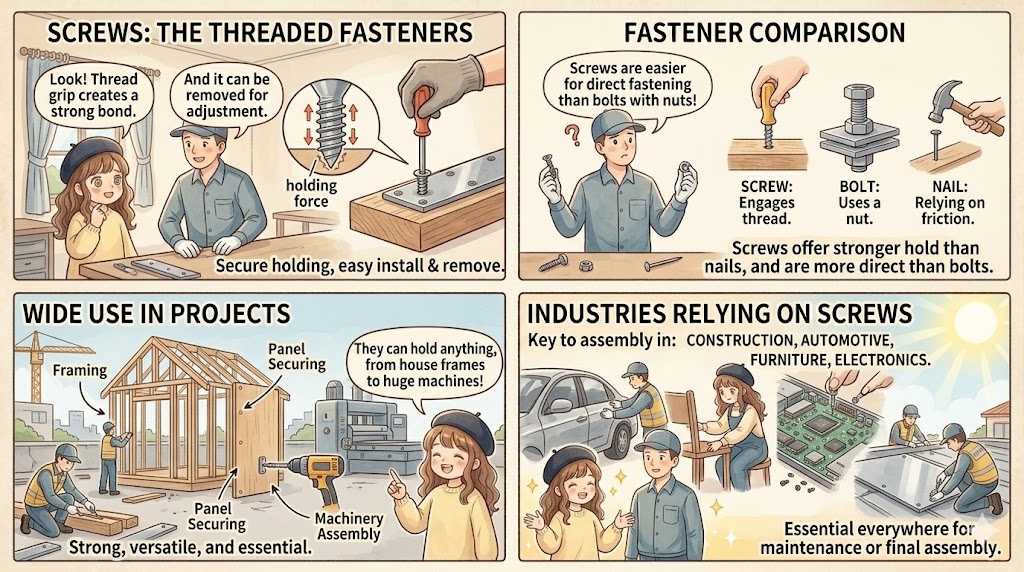
Screws are threaded fasteners designed to join two or more materials together. When a screw is driven into a material or matching threaded hole, its spiral thread creates grip and holding force.
This makes screws useful for applications that require secure fastening, easy installation and, in many cases, future removal or adjustment.
What is the difference between screws, bolts and nails?
Screws usually create or engage threads as they are installed, while bolts are commonly used with nuts or pre-threaded holes. Nails, on the other hand, rely mainly on friction and impact-driven installation.
Compared with nails, screws generally provide stronger holding power and are easier to remove. Compared with bolts, screws are often more convenient for direct fastening into wood, metal, plastic or sheet materials.
Why are screws widely used in industrial and construction projects?
Screws are popular because they are strong, versatile, easy to install and available in many sizes and materials. In construction and industrial work, they help secure panels, frames, machinery parts, brackets, metal sheets and structural components.
Their ability to provide reliable fastening makes them essential in both temporary and permanent assemblies.
Which industries rely heavily on screw fasteners?
Common industries include construction, automotive, furniture, electronics, machinery, aerospace, appliance manufacturing, renewable energy and metal fabrication.
Any industry that needs stable assembly, maintenance or component fastening is likely to use screws.
Section Two: What Are the Common Types of Screws?
Self-tapping screws vs machine screws: what’s the difference?
Self-tapping screws are designed to create their own threads as they are driven into material. They are commonly used for sheet metal, plastics and light industrial assembly.
Machine screws are typically used with pre-threaded holes or nuts. They are common in machinery, electronics, equipment housings and precision assemblies.
Wood screws, drywall screws and metal screws explained
Wood screws are designed with threads that grip wood fibers securely. Drywall screws are used to fasten drywall panels to wood or metal studs.
Metal screws are designed for fastening metal parts, panels or sheets. Depending on the application, they may require pilot holes, tapped holes or self-drilling tips.
Stainless steel screws vs carbon steel screws comparison
Stainless steel screws offer better corrosion resistance, making them suitable for outdoor, marine, humid or food-related environments.
Carbon steel screws are strong and cost-effective, but they often require coatings such as zinc plating, black oxide or other surface treatments to improve rust resistance.
Which screw head types are most commonly used today?
Common screw head types include flat head, pan head, round head, hex head, socket head and countersunk head.
Drive types also vary, including Phillips, slotted, hex socket, Torx and square drive. The right head and drive type depend on installation tools, appearance requirements and torque needs.
Section Three: How Do You Choose the Right Screw?
Does screw material affect durability and strength?
Yes. Screw material directly affects strength, corrosion resistance and long-term performance. Stainless steel is suitable for corrosion-prone environments, while carbon steel is often chosen for strength and cost efficiency.
For high-load applications, material grade and mechanical strength should be carefully reviewed.
How to choose the correct screw size and thread type
Screw size should match the material thickness, load requirement and installation method. A screw that is too short may not provide enough holding force, while one that is too long may damage the material.
Thread type also matters. Coarse threads are often used for wood and softer materials, while fine threads are better for metal and precision fastening.
Why coating and corrosion resistance matter in outdoor use
Outdoor screws are exposed to moisture, temperature changes and UV exposure. Without proper corrosion resistance, screws may rust, weaken or stain surrounding materials.
Common protective options include zinc plating, hot-dip galvanizing, stainless steel and specialty anti-corrosion coatings.
Which screws are suitable for heavy-duty applications?
Heavy-duty applications usually require high-strength screws, larger diameters, deeper thread engagement and suitable materials. Hex head screws, structural screws and high-grade machine screws are often used in demanding environments.
The final choice should consider load, vibration, installation surface and safety requirements.
Section Four: Where Are Screws Commonly Used?
Construction and building fastening applications explained
In construction, screws are used for framing, roofing, decking, drywall, metal panels, brackets, fixtures and structural connections.
The correct screw must match the building material and environmental conditions, especially for outdoor or load-bearing work.
How screws are used in furniture manufacturing
Furniture manufacturing uses screws to assemble wood panels, metal frames, hinges, drawer slides, handles and hardware.
Screws allow furniture to be assembled efficiently and repaired or adjusted when needed.
Automotive and machinery industries’ fastening requirements
Automotive and machinery applications require screws that can withstand vibration, load, heat and long-term operation. These industries often use machine screws, socket screws, self-tapping screws and specialty fasteners.
In critical assemblies, torque control and quality standards are especially important.
Electronics and precision equipment screw applications
Electronics often use small precision screws to fasten circuit boards, housings, brackets and internal components. These screws must be accurate, consistent and suitable for delicate materials.
Precision equipment may require stainless steel, miniature screws or special head designs.
Section Five: What Factors Affect Screw Performance?
Why improper screw selection can lead to fastening failure
Using the wrong screw can cause stripping, loosening, material cracking, corrosion or insufficient holding strength. For example, using indoor screws outdoors may lead to rust, while using the wrong thread type may reduce grip.
Choosing screws should always be based on application, material and environment.
How torque and installation methods affect screw stability
Over-tightening can strip threads, damage material or break the screw. Under-tightening may result in loose connections.
Using the correct torque, pilot hole size and installation tool helps improve fastening stability.
What causes screws to loosen over time?
Screws may loosen due to vibration, thermal expansion, material shrinkage, improper torque or repeated loading. In machinery and automotive applications, thread-locking compounds, washers or locking designs may be needed.
How environmental conditions impact screw lifespan
Moisture, chemicals, salt air, heat and outdoor exposure can reduce screw lifespan. In harsh environments, corrosion-resistant materials and coatings are essential.
Regular inspection is also important for safety-related applications.
Section Six: What Should You Know Before Buying Screws?
Bulk screw purchasing vs small quantity orders
Bulk purchasing is more cost-effective for factories, contractors and manufacturers with stable demand. Small quantity orders are better for repair work, samples, prototyping or one-time projects.
Before buying in bulk, it is important to confirm size, material, coating and quality requirements.
OEM and custom screw manufacturing options explained
OEM and custom screw manufacturing may be needed when standard screws cannot meet specific design, strength, size or application requirements.
Custom options may include special head types, thread designs, materials, coatings or dimensional tolerances.
Quality standards and certifications to look for
Industrial screws may need to meet specific standards depending on application and market. Common considerations include material grade, dimensional tolerance, tensile strength, coating thickness and corrosion resistance.
For critical applications, suppliers should provide inspection reports or quality documentation.
How to evaluate a reliable screw supplier
A reliable screw supplier should offer stable quality, clear specifications, material traceability, production capacity and responsive service.
For industrial buyers, consistency is often more important than the lowest price.
Section Seven: What Are the Latest Trends in the Screw Industry?
Why stainless and anti-corrosion screws are becoming more popular
As outdoor construction, renewable energy, marine applications and high-humidity environments grow, demand for stainless steel and anti-corrosion screws continues to increase.
Longer product lifespan and lower maintenance costs are key reasons for this trend.
Automation and smart manufacturing in fastener production
Fastener production is becoming more automated, improving dimensional consistency, production speed and quality control.
Automation also helps suppliers meet large-volume industrial demand more efficiently.
Eco-friendly materials and sustainable fastener development
Sustainability is becoming more important in manufacturing. Some fastener producers are focusing on recyclable materials, cleaner coatings and more efficient production processes.
This trend is especially relevant for global supply chains and environmentally conscious industries.
How the global fastener market is evolving in modern manufacturing
Modern manufacturing requires faster delivery, tighter tolerances, customized specifications and stronger quality control. Screws are no longer viewed as simple components, but as important parts of product reliability and assembly performance.
Conclusion
Screws are one of the most essential fastening components across construction, manufacturing, electronics and industrial applications. Different screw materials, thread types, coatings and head designs all affect durability, installation performance and long-term reliability.
When selecting screws, it is important to consider not only price, but also application environment, material compatibility, fastening strength and quality consistency. Choosing the right screw helps improve assembly stability, reduce maintenance problems and extend product service life.
FAQ
Q:What is the difference between screws and bolts?
A:Screws are often driven directly into materials or threaded holes, while bolts are commonly used with nuts or pre-threaded components.
Q:Which screws are best for outdoor use?
A:Stainless steel screws, galvanized screws and coated corrosion-resistant screws are commonly used outdoors.
Q:What are self-tapping screws used for?
A:Self-tapping screws are used to create threads while fastening materials such as sheet metal, plastic or light structural components.
Q:How do I choose the correct screw size?
A:Choose based on material thickness, load requirement, thread engagement, pilot hole size and application environment.
Q:Why do screws loosen over time?
A:Screws may loosen because of vibration, improper torque, thermal expansion, material movement or repeated loading.
Q:What materials are commonly used for industrial screws?
A:Common materials include stainless steel, carbon steel, alloy steel, brass and specialty metals for specific industrial applications.